
Do you want to learn more about organizing an aerial silk performance?
The circus consists of a multitude of disciplines that can be grouped into several categories. For example, juggling is a set of well-known and easily identifiable disciplines. Balancing, physical expression, clowning, and acrobatics are all well-known disciplines within the circus arts. In this article, we offer you an overview of the aerial disciplines of the circus.
The Aerial Disciplines Category
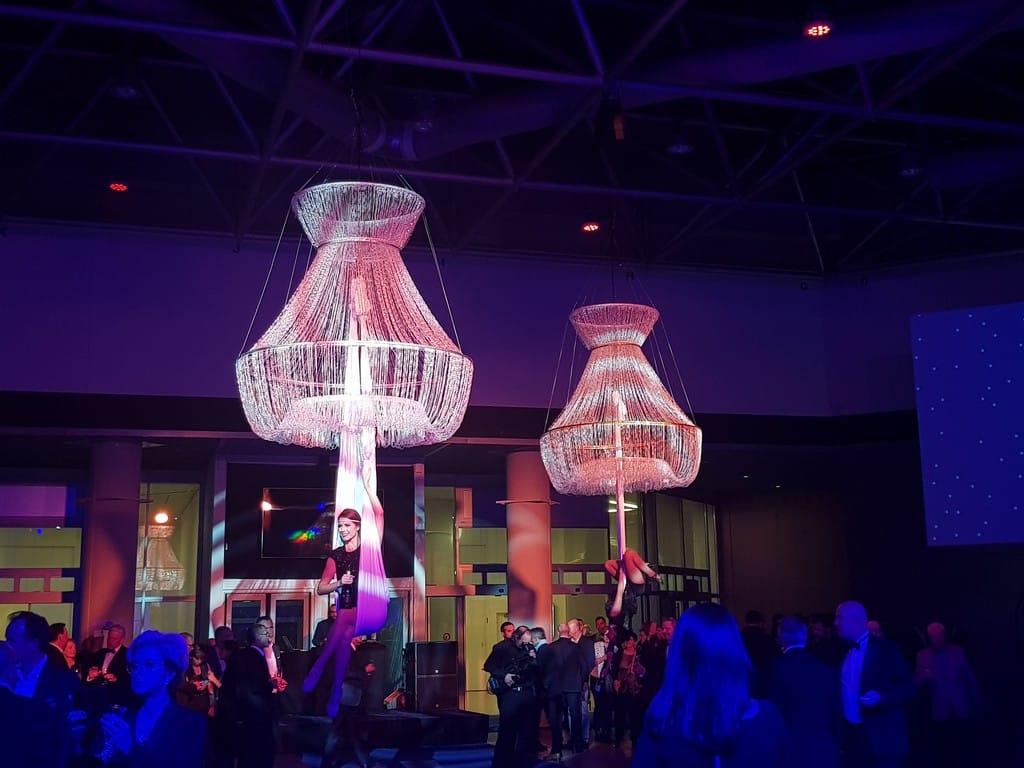 This category can be considered a variant of the acrobatics category, in that the movements and physical performances are very similar. To define the category more precisely, it is considered to use only apparatus hanging from the ceiling.
The main characteristics of aerial disciplines mainly concern performing in a vertical environment and the loss of usual spatial references. Added to this, of course, is controlled risk-taking and the need to overcome one’s fears to launch oneself above the void.
The Different Trapezes
Trapeze disciplines are all considered aerial, although the fixed trapeze sits between aerial and acrobatic. The trapeze appeared in circus shows in Italy around 1850 (the Francesco brothers) and was also adapted for military training. Indeed, practicing the fixed trapeze is considered very hard on the body, even masochistic, and can cause injuries.
The fixed trapeze simply consists of a bar (often metal) hanging from two fairly rigid ropes. As the name suggests, it moves very little, which explains the harsh nature of the discipline.
The flying trapeze is attached to longer ropes, and the acts exploit the long swinging movements of the apparatus to create spectacular figures.
The flying trappetze generally consists of two (or more) swing-type trapezes and two high platforms where the artists stand in their starting position. Its origins date back to 1859 when Jules Léotard jumped into the void while holding a trapeze and flew by successively catching three trapezes. There are many variations, often with two artists, one catching the other and lifting them. Combining strength and agility, it is probably the most spectacular of the disciplines, but it is uncommon because it requires installations at least 9 meters high and 15 meters wide.
Aerial Silk
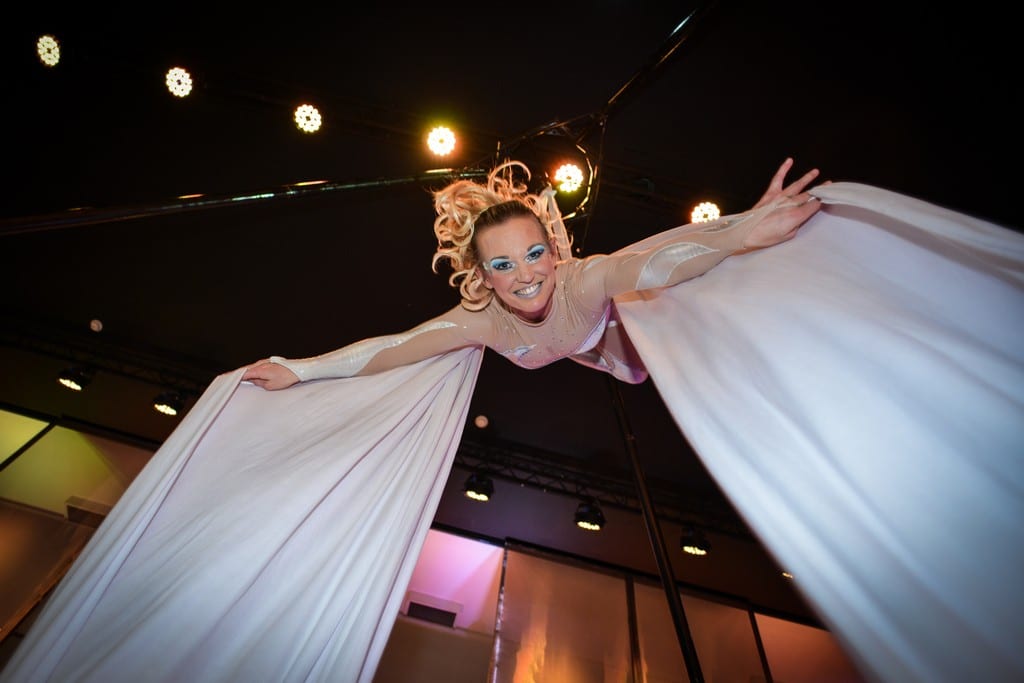 Appearing in France in the early 1990s (with distant Chinese origins), this recent apparatus consists of flexible fabric strips hanging from the ceiling. The artist or artists perform primarily using arm strength, using the flexibility of the fabric to wrap it around various parts of their body and thus hold themselves in the air. It is an evolution of the aerial rope, more aesthetic thanks to the colors and movements of the fabric. A true aerial dance, this discipline has become very popular, but tends to lose momentum, perhaps due to being overused.
Often considered feminine, this discipline could reinvent itself with the growing interest of men, seeking new forms of expression and breaking down gender barriers.
Chinese Pole
As its name suggests, this discipline comes from China and finds its origin in fruit picking at the tops of trees. It truly sits between the aerial and acrobatic categories, depending on whether the pole is attached to the ceiling or placed on the ground.
Strangely called “machinistes,” artists specializing in Chinese pole must climb it and perform figures, or even real jumps, catching themselves just above the ground, or jumping from one pole to another. This discipline is tough; hits and burns are common. The discipline follows the reverse path of the aerial silk. Once considered masculine, it is attracting more and more women.
While we have only touched upon the basics of aerial disciplines, know that Eklabul offers you a rich diversity of forms of expression throughout the Côte d’Azur. Aerial hoop, aerial clover, champagne lustre… we tirelessly seek diversity and the exploration of new disciplines.